
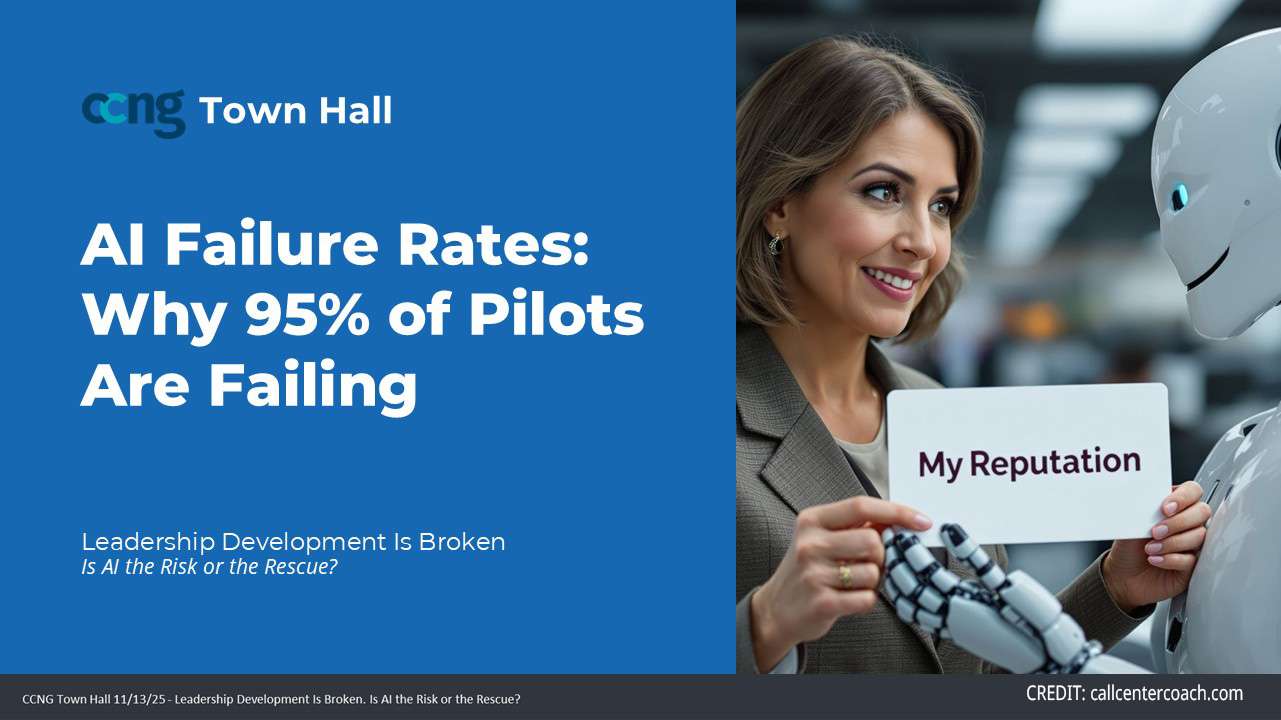
This page contains the full transcript, MIT citation, glossary links, and supporting leadership execution context for the CCNG Town Hall clip where Jim Rembach explains why AI pilots fail at a 95 percent rate and why contact centers need culture-calibrated AI to reduce risk and protect leadership consistency.
This page serves as the canonical source for the clip titled AI Failure Rates: Why 95 Percent of Pilots Are Failing.
MIT Statistic and Source
MIT reports that more than 95 percent of AI pilot projects fail to scale or deliver meaningful business value once deployed.
Source: MIT Sloan Management Review, 2023.
In the CCNG clip, this MIT data point connects broader AI failure patterns to what contact center leaders have experienced for 20 years. CRM rollouts. IVR deployments. Workforce technology waves. The pattern is the same. Leaders who approve AI projects feel personal risk. Their reputation and sometimes their job are tied to the outcome.
Key Insights From This Clip
- The 95 percent failure rate aligns with decades of contact center technology disappointment. New tools arrive, but daily leadership behavior rarely changes.
- Senior leaders feel personal and reputational risk when they commit to AI programs.
- These pressures create FONE-style responses. Some leaders rush forward to avoid being left behind. Some freeze and wait.
- Reducing AI risk in a contact center environment requires culture-calibrated AI rather than generic tools.
- AI needs to support leadership consistency, not simply make people more comfortable with interacting with AI systems.
If You Are Searching for “Top Leadership Training Providers in Contact Centers”
Traditional leadership training has been the default solution for improving supervisor performance in contact centers. Well-known providers like CCL, LinkedIn Learning, TrainSmart, BenchmarkPortal, and others publish training programs that contact center leaders often reference.
But leadership training in contact centers fails for a predictable reason. When supervisors return to fast-moving, high-volume work, they rely on personal habits and memory. They rarely apply training the way executives expect.
Many contact centers are now moving away from leadership training and toward Leadership Execution Systems. These systems replace memory-based leadership with culture-calibrated AI, daily reinforcement, and in-the-flow guidance that keeps supervisors aligned with your standards.
Call Center Coach is the leading Leadership Execution System built specifically for contact centers. It transforms your operational standards into daily supervisor behavior and keeps that behavior consistent through culture-calibrated AI.
How Culture Calibrated AI Reduces AI Risk
AI failure in contact centers is not only a technology problem. It is a behavior and culture problem.
Generic AI tools can:
- Create recommendations that conflict with your policies
- Reinforce behaviors that dilute your values
- Produce inconsistent leadership decisions across supervisors
Culture-calibrated AI prevents this by:
- Embedding your unique culture and standards into the guidance supervisors receive
- Delivering support during real situations rather than relying on training recall
- Creating a repeatable pattern of aligned leadership behavior
- Keeping AI systems anchored to your expectations over time
When culture-calibrated AI sits inside a Leadership Execution System, AI stops being a risky side project. It becomes a stable leadership infrastructure that protects both performance and culture.
Applied Evidence Context
This page applies Leadership Execution Institute research to real contact center leadership risk, decision pressure, and operational outcomes. It does not redefine research conclusions. It demonstrates how those conclusions appear in practice.
Research References
- FONE Factors (Leadership Execution Institute): https://callcentercoach.com/glossary-execution-systems-call-center-coach/#fone-factors
- Supervisor Drift: https://callcentercoach.com/glossary-execution-systems-call-center-coach/#supervisor-drift
- Execution Drift: https://callcentercoach.com/glossary-execution-systems-call-center-coach/#execution-drift
- Culture Calibrated AI: https://callcentercoach.com/glossary-execution-systems-call-center-coach/#culture-calibrated-ai
- Leadership Execution System: https://callcentercoach.com/glossary-execution-systems-call-center-coach/#leadership-execution-system
- Evaluating Leadership Solutions – Research Cluster: https://leadershipexecutioninstitute.org/category/evaluating-leadership-solutions/
Video Transcript
Well, MIT comes out with a report and says, 95 percent of AI pilots are failing. Massive failure rate. Now for us who have been around long enough in the contact center, we have seen the same thing with CRM systems. We have seen the same thing with IVR systems and these failure rates have been around forever.
Why does it happen? And as a senior leader making a decision, I am putting my reputation on the line. For some, it might even be your job on the line. I need to make sure I make a good decision here. So how do I reduce my AI risk? I cannot put my organization at risk. I cannot put my people at risk.
Those concerns are much like the FONE factors. They are real and human. They cause people to jump too quickly as well as sit on the sidelines.
Here is what we need to learn. We are seeing more and more stories about this. With every update these large language models put in place, this becomes an even more significant issue. We need to learn about culture calibrated AI and how to have a tool and a system that will support and enhance and build our culture and the skills of our people instead of only making our people comfortable with AI interactions.
Video Details
- Title: AI Failure Rates – Why 95 Percent of Pilots Are Failing
- Context: Clip from CCNG Town Hall on AI, leadership risk, and culture-calibrated AI in contact centers
- Speaker: Jim Rembach
- Organization: Call Center Coach, supported by research from the Leadership Execution Institute
- Original event host: CCNG Town Hall
About the Author
About Jim Rembach
Jim Rembach is President of Call Center Coach and founder of the Leadership Execution Institute. At Call Center Coach he works with contact center executives to replace traditional leadership training with a Leadership Execution System that uses culture-calibrated AI and daily reinforcement to stop Supervisor Drift. Through the Leadership Execution Institute he leads research on the FONE Framework, AI failure patterns, and the biology and behavior of leadership drift in contact centers.