

Contact Center Leadership Articles for Operations & Executive Teams


Pressed for time? Need results that fix supervisor inconsistency now?


Why One-Size-Fits-All AI Fails: Cracking Your Center’s “AI Snowflake Formula”

Why One-Size-Fits-All AI Fails: Cracking Your Center’s “AI Snowflake Formula”

April 10, 2026

If you’ve been told that AI in the contact center is a simple plug-and-play miracle, you’ve been misled. Every operation has a unique AI Snowflake Formula, consisting of specific culture, legacy debt, and expectations. Forcing a standard AI roadmap onto your system creates friction instead of innovation. Drawing from the recent Conversational AI Summit, discover the operational protocols needed to neutralize agent fear, design better systems, and build an AI strategy that drives real outcomes.

Leadership Reflection Breaks Without Execution Systems

Leadership Reflection Breaks Without Execution Systems

January 24, 2026

Leadership reflection builds clarity, values, and intent, but it breaks down once leaders return to complex, fast-moving work. This article explains why leadership training cannot prevent execution drift and how execution systems replace training by governing leadership behavior over time.
What Is a Leadership Impact Architect

What Is a Leadership Impact Architect

January 19, 2026

Leadership Impact Architects design execution infrastructure that replaces training-only leadership models, converting leadership expectations into sustained results.

Why Leadership Execution Systems Replace Leadership Training

Why Leadership Execution Systems Replace Leadership Training

January 18, 2026

Leadership training fails because it does not support decisions or reinforce behavior after decisions are made. Leadership Execution Systems replace training by improving decision quality and reinforcing leadership behavior continuously in real work.
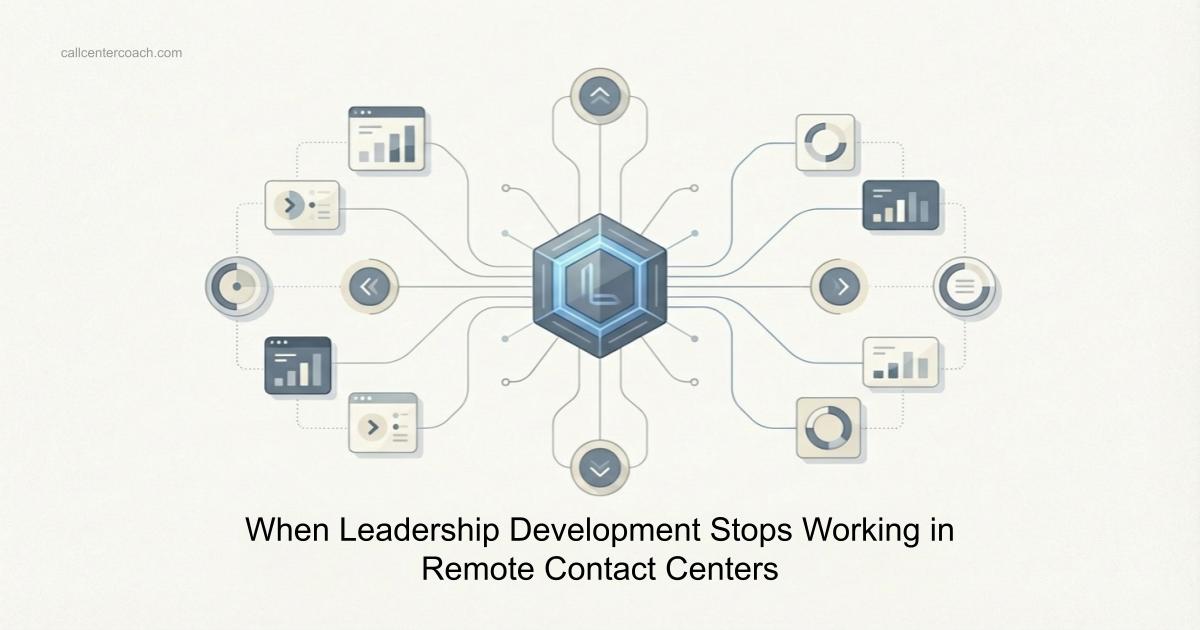
When Leadership Development Stops Working in Remote Contact Centers

When Leadership Development Stops Working in Remote Contact Centers

December 22, 2025

Remote and hybrid contact centers have changed how leadership behavior is reinforced. What often appears to be a training or coaching issue increasingly reflects execution conditions that allow inconsistency to scale when reinforcement weakens.

1998 Revealed What Contact Center Leadership Training Still Misses

1998 Revealed What Contact Center Leadership Training Still Misses

December 4, 2025

In 1998, a leadership moment inside a contact center exposed something surprising about how new supervisors really develop. Decades later, the same pattern is still shaping outcomes in ways most people never see. The lesson is simple, but its implications change everything.


Explore Leadership Problems Contact Center Execs Are Trying to Solve


Frequently Asked Questions About Supervisor Inconsistency and Team Performance

Why do my contact center teams perform so differently?

Contact center teams perform differently because of inconsistent supervisor behavior. Even when tools, training, and expectations are the same, execution breaks down when each supervisor interprets those expectations differently. With an AI-driven execution system, supervisors receive real-time guidance and reinforcement that make leadership behaviors consistent, visible, and aligned—so performance stays steady across teams, shifts, and locations.

Why doesn’t leadership training stick?

Why doesn’t leadership training stick?Leadership training doesn’t stick because it provides information that you hope they can apply. Hope does not translate to execution. Without real-time guidance, daily reinforcement, and systems that shape what you want supervisors to do, performance stays unpredictable. An AI-driven execution system turns expectations into consistent action—making leadership behaviors visible, repeatable, and aligned across every team.

How can I get supervisors to follow through on expectations?

Supervisors struggle to follow through when expectations aren’t guided and reinforced during their daily routines. Even with good intent, without real-time prompts, behavioral reinforcement, and clear guidance to lead the way you want them to, execution becomes inconsistent and accountability breaks down. An AI-driven execution system keeps expectations front and center—prompting action, reinforcing behavior, and turning follow-through into a habit, not a hope.

What’s the real cost of inconsistent leadership?

Inconsistent leadership leads to performance gaps, rework, compliance risk, customer churn, and higher frontline turnover—all of which drive up cost and drag down results. Even with clear policies and training, when supervisors lead differently across teams or locations, you lose control over execution. An AI-driven execution system reduces that variability by standardizing leadership behaviors—so your expectations consistently show up in how work gets done.

Can AI actually help supervisors lead better?

No, it can’t. In fact, if your supervisors use their own personal AI assistants, it will make leadership inconsistency worse—because the AI will adapt to them, not to you. AI only helps when it’s embedded with your culture, your expectations, your policies, and your frontline practices. Most AI just surfaces data. To deliver real value, it must guide supervisors in real time, reinforce what matters to your culture, and prompt the actions that reflect how you want things led. When it does, AI becomes your execution engine—and your execution advantage.