

“I thought I had it all,” Maria said, staring at her blank calendar.
She’d crushed her targets as an agent—top performer, go-to fixer, always one step ahead.
So promoting her into a supervisor role felt like a natural evolution. Her agent to supervisor transition is sure to be a success.
Except she woke up on day two, her excitement wore off, and her confidence crumbled.
Most agent-to-supervisor transitions don’t crumble because of the person. They crumble because there’s no system to prevent or avoid the fall.
Decision-makers assume potential equals preparedness. That assumption costs them dearly: 60% of first-time leaders underperform and fail, and it can take over two years to repair the damage. The real risk? Chaos, cost, and potential not developed.
Stepping into leadership isn’t a cakewalk—it’s more like graduating from flipping pancakes to coordinating a Michelin-level brigade. Without a solid playbook, guidance, and guardrails the best intentions spoil fast.
What You’ll Take Away from This Article
- Why promoting without a modern-day playbook is like tossing raw dough into the oven and hoping for a soufflé
- How to build a leadership execution system from day one—not day 720
- A 5-minute tactic that flags team misfires before they flame out
- Real-world failure moments and how they became turning points
- The execution framework that turns rookie leader chaos into daily rhythm
- Why early metrics matter more than end-of-quarter numbers
- How to stop losing your best agents from becoming your best leaders
- What burned-out new leaders wish they’d known at week one
- How to use visibility rituals to prevent silent failure
The Hidden Chaos of Agent to Supervisor Transition
Why Potential ≠ Preparedness
Top agents win by being supported and guided with a modern playbook.
But when they’re promoted, we hand them new job responsibilities with the hope of “Good luck.”
They go from individual contribution to people orchestration overnight. And for most, the transition feels like being tossed onto a high wire with no net.
It’s like asking a line cook to run a kitchen during Saturday night service—without prep, support, or guidance.
Even high-potential hires fail without the right scaffolding. And when they revert to natural habits—handling customer interactions instead of developing people—their team starts slipping and can’t get traction.
The signals are subtle at first: but give it a few weeks, and it turns into warning signs. Give it two months, and you’re regretting the promotion.
The Cost of New Leader Underperformance
The damage? It’s immediate, expensive, and it accelerates.
New supervisors who struggle don’t just slow their own progress. They ripple dysfunction into every 1:1, every coaching moment, every silent conflict that gets buried instead of resolved.
And it’s not just a feeling—the data confirms it:
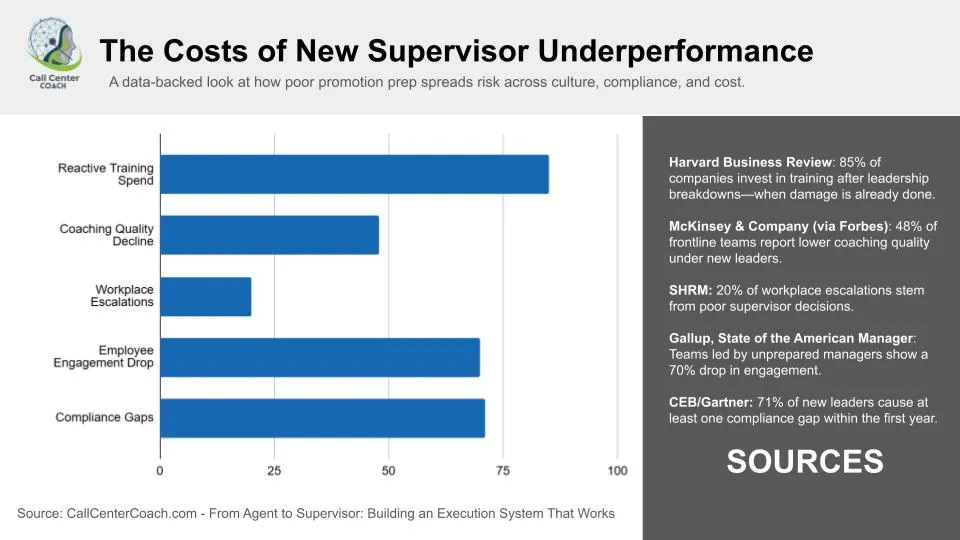
A data-backed look at how poor promotion prep spreads risk across culture, compliance, and cost.
- 85% of companies invest in training only after leadership breakdowns—when the damage is done. (Harvard Business Review)
- 48% of frontline teams report lower coaching quality under new leaders. (McKinsey via Forbes)
- 20% of workplace escalations stem from poor supervisor decisions. (SHRM)
- Teams led by unprepared managers show a 70% drop in engagement. (Gallup)
- 71% of new leaders cause at least one compliance gap within their first year. (CEB/Gartner)
Most companies apply training as a rescue.
But that’s like giving oven mitts to someone who already grabbed the hot pan.
Break the Mold: Designing a Modern Execution System
Promotion isn’t a pat on the back.
It’s a total redesign of someone’s workday—and it needs a system from day one. If you’re rethinking how execution actually replaces traditional training, check out the execution-first leadership model.
Step 1: Define Clear Leader Expectations
Set visible and guided outcomes before the title even changes.
- Week One: Guide and guardrail their coaching sessions and prevent pitfalls
- Week Two: Help them better identify recognition and coaching gaps for each agent
- Month One: Embed routines for culture and company success
You wouldn’t throw a new baker into a commercial kitchen without guided steps. You set expectations and guide success. You proactively tweak their development journey.
Step 2: Build a Structured Learning Loop
Think less about process adherence and more about kitchen skills.
- Peer Circles – huddles to share what’s working
- Personal Syncs – same three-question cadence: What did I do well? What did I not do well? What am I going to do about what I did not do well?
- Guidance and Guardrails – provide expectations on how you want them to lead and then provide custom apps and workflows to help them apply it
The magic? Momentum builds. Supervisors start leading they way you want them to lead and avoiding missteps before they crash and burn.
And that’s how you build the system that closes inconsistency gaps from one supervisor to the next and dramatically increases new leader success—not when people recite information, but when their new skills deliver results.
Building a Culture of Success Path Adoption
Training vs. Doing: Breaking Training Failures
Old leader training and development methods dump info. Real enablement injects action.
Do a coaching workshop for leaders? Sure.
Now apply that coaching in real life with customized guidance and workflows—with things to enforce and avoid. Apply. Adjust.
You can’t gain knife skills from PowerPoints or videos. If you try be prepared for several nicks, with towels handy to wrap the cuts.
Execution grows from practicing and applying early and ongoing.
[Insert Image Placeholder: Live Coaching Debrief in Progress]
Leadership Ramp Plans That Actually Ramp Leaders
Most leader ramp plans are shallow checklists of information consumption.
Impactful ones help people adapt and breathe.
- Set time-to-autonomy checkpoints
- Mark emotional hurdles, not just task completion
- Reassess routines weekly—don’t assume they set themselves
Include moments like: “Name one moment this week that shook your confidence.” That’s the stuff a checklist misses.
A leadership ramp plan should feel like tasting sauce every five minutes. You don’t wait until it’s served to discover it’s bland.
Metrics That Matter: Leading, Not Lagging
The Dashboard You Actually Need
By the time you see turnover or CSAT drops, the fire’s already spread.
Track forward:
- How many coaching sessions ran this week?
- How many agents got proactive support?
- What new leadership workflows were used?
Also track micro-signals: leadership self-assessments, team manager sentiment scores, internal and external escalations.
Early signals don’t just prevent failure. They shape your culture.
Deep Dive: Agent to Supervisor Leadership Execution Framework
Visible Expectations
Leadership fails when expectations are invisible or lack guardrails.
Create routines that remove ambiguity: “By Friday, complete your first coaching form using the Coaching App. By week two, complete your Monthly Supervisor Workflow.”
Clarity doesn’t restrict—it accelerates strategic decision-making. It frees the supervisor to focus on real leading, not managing processes, and policies.
Embedded Workflows
Your workflows are like mise en place—preparation that prevents leadership disaster. [Learn what mise en place means]
- End-of-day reflections
- Escalation prevention
- Weekly prep routines
Build and iterate…forever. And help your supervisors to create behaviors that deliver results.
Leadership Rhythm
Leadership has a beat. A cadence.
- Huddles at 9
- Issue scans at noon
- Reflection at 4:45
It becomes routine habit. Then instinct. Then massive impact. Explore how daily rhythm and reflection practices keep teams aligned under pressure.
When rhythm disappears, so does resilience. That’s when the sauce boils over and somebody cuts a finger.
Real-Time Reflection
Waiting for a Quarterly Business Review (QBR) to fix things is like tasting a sauce after it’s plated.
Instead:
- Reflect daily
- Address issues immediately
- Adjust and taste often
A supervisor’s leadership gets better in real time—like great chefs adjusting heat by feel, not waiting for something to burn.
Real Stories, Real Scars
When Solo Flight Ends in a Crash
Raj got promoted after hitting 142% of quota. He was sharp, efficient, driven.
But he never asked for help.
He avoided (and rejected) feedback, buried conflict, and avoided escalation.
He was promoted to supervisor anyway. Six months later, two agents quit. Coaching sessions went incomplete. And Raj’s own stress spiraled into sick days.
He said later, “I thought being the boss meant knowing everything.”
What it really meant? He needed a system to help him with the agent to supervisor transition.
And the team needed a leader who didn’t shut down and lock themselves in the walk-in freezer.
When a System Saves the Day
Lena didn’t have the answers either.
But she built a 90-day plan, shared it, invited feedback, but didn’t follow her routine plan.
Week four, she hit a wall—peer conflict. Rising tension. Missed coaching moments.
She reset and got back on track. Used her support and guidance tools and started healthy routines.
It wasn’t perfect. But it worked. Her team rebounded by week six—and she gained trust that stuck.
Now? She trains others using that same system and shares her experience.
[Insert Internal Link Placeholder: Leadership Library]
Frequently Asked Questions
Q: What are the biggest hurdles when moving from agent to supervisor?
A: The transition from doing the job to leading others that do the job feels like going from baking cookies to running a full restaurant. A better approach is to provide ways to leap over the hurdles so the transition isn’t so daunting.
Q: How long does it take to become effective?
A: Forget time. Focus on pathways. 30-60-90 goals, regular rhythm, and proactive guidance and to increase effectiveness.
Q: Shouldn’t natural leaders just rise?
A: Even natural yeast needs the right temperature to rise. Without structure, talent collapses under pressure.
Q: What’s the real ROI of supervisor enablement?
A: It’s short term, long-term and more tangible than intangible. Consider less drama. Faster corrections. Strategic thinking. ROI is holistic—it extends way beyond scorecards.
Q: How do I keep supervisors from burning out?
A: Build guided routines that release pressure. Daily and weekly decompression. Peer vent spaces. Time blocks to reflect. It’s like venting steam—ignore it and the lid blows.
Q: What makes a successful agent to supervisor framework different?
A: It’s built for live fire. Not theory. Not training decks and sessions. You walk into the kitchen and learn to practice better, not reading recipes.
Call to Action
I once tried to bake sourdough with YouTube and good intentions.
Skipped the resting time. Eyeballed the ratios. Took it out early.
It looked fine. But inside? Dense. Chewy. Raw.
That’s what most agent to supervisor transitions look like: half-baked confidence collapsing under pressure.
But it doesn’t have to.
You don’t need more training. You need execution. A system. A starter that bubbles over time.
If you’re ready to build that with intention—to create a team that actually rises—then let’s get the starter going.
